
Lost in Translation (2003)

4/10
Bougie. Empty. Tedious. These are words that came to mind watching Lost in Translation, which is exactly the kind of overrated critical darling I feared it would be. It’s a nice-looking movie with little to say. Portraying a wealthy, privileged layer characterized by its self-absorption and lack of purpose might be a plus if this movie were more satirical. Unfortunately, writer and director Sofia Coppola—daughter of legendary director Francis Ford Coppola, who has often been guilty of nepotism and serves as an executive producer—displays no such self-awareness. The result is a lot of navel-gazing with some pretty shots and exotic scenery.
To be clear, being a “nepo baby” does not make someone incapable of being talented or skilled in their own right. Coppola clearly has technical skill as a director. That’s not the issue. The question is whether she’s able to tell an interesting story here, and although I’m clearly in the minority, Lost in Translation fails that test for me. Except for a couple memorable scenes, the result is mostly a big shrug.
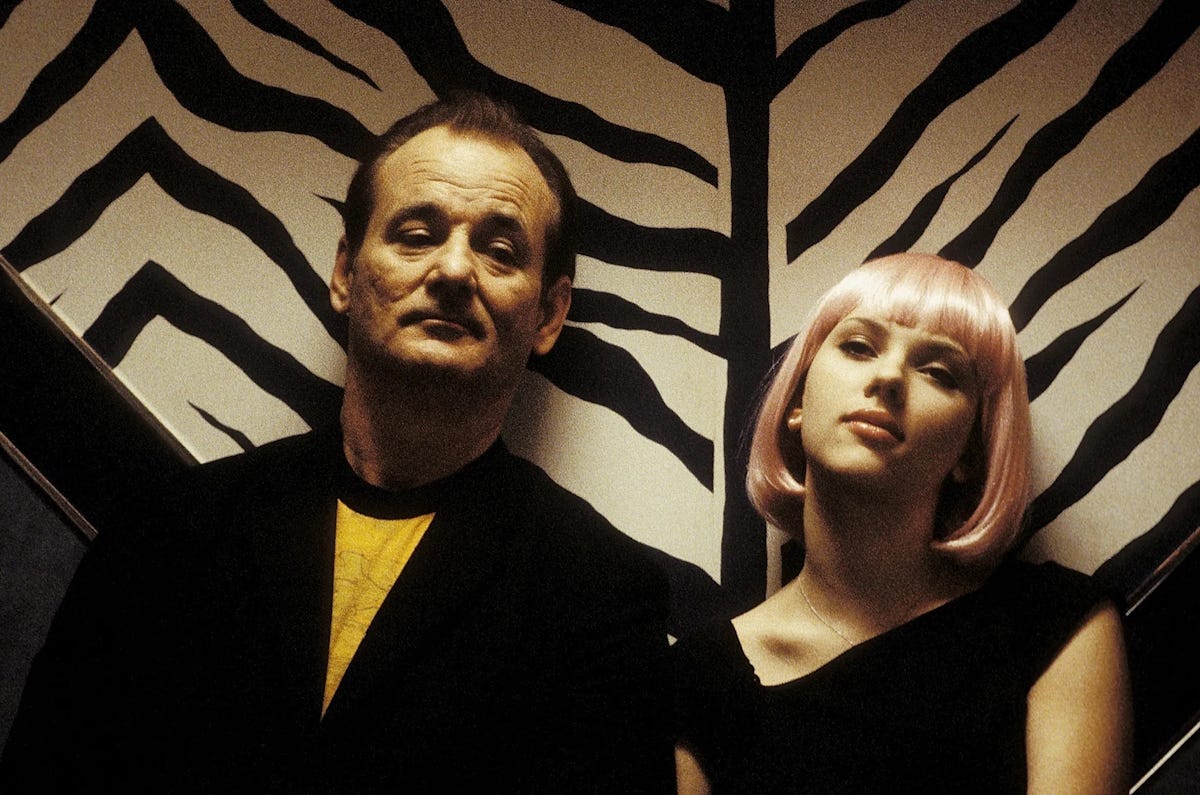
Let’s start with the characters. Bob Harris (Bill Murray) is a washed-up movie star who is in Japan to shoot a whiskey commercial, for which he is being paid $2 million, and experiencing a midlife crisis. Charlotte (Scarlett Johansson) is a recent Yale graduate left to her own devices while her husband John (Giovanni Ribisi), a celebrity photographer, works on a shoot. The two meet at their hotel and develop a relationship based on shared feelings of loneliness.
Both of these characters exist in an insulated bubble of wealth and celebrity, i.e. the entertainment industry, which is also the milieu Sofia Coppola was raised in. Both are going through what should be relatable experiences—Bob a midlife crisis, Charlotte trying to figure out what she wants to do with her life—that become diluted through their material circumstances. Bob is a rich, famous actor, even if one on his way down. We spend a few scenes listening to him talk on the phone trying to choose a colour for his study, which although he clearly doesn’t care just underscores how insignificant his problems are.
Unlike a lot of young workers, Charlotte has no immediate pressure to get a job thanks to her husband’s lucrative profession. But her character feels more insufferable after Coppola goes out of her way to tell us Charlotte is smart because she attended an Ivy League school. When actress Kelly (Anna Faris), portrayed as an airhead who is in Japan to promote her new blockbuster, makes an error about the writer Evelyn Waugh—not realizing Waugh was a man—Charlotte points out this minor faux pas to John, who responds, “Oh come on, she’s nice. Not everyone went to Yale.” (My emphasis.)
We’re supposed to sympathize with Charlotte finding Kelly repellent for being dumb and vacuous. It has the opposite effect by making Charlotte seem like a condescending elitist who looks down on Kelly for being unfamiliar with one aristocratic 20th-century British writer. (Maybe there’s also envy, since Kelly is successful and doing something with her life other than hanging around a hotel.) Screenwriters often use a character attending an Ivy League university as shorthand for being intelligent—yet many Ivy League students are legacy admissions who are only accepted because they come from wealthy families. People who benefit from nepotism or rich parents often can’t acknowledge this fact and maintain they achieved success purely through their own talent, intelligence or hard work. That Coppola includes the “Ivy League = smart” trope is revealing.
The Wikipedia article for Lost in Translation says the film “does not use mainstream narrative conventions and is atypical in its depiction of romance.” That’s one way to say that very little happens and the central romance is underwhelming. At the end I didn’t care what happened to these two characters. There’s one scene where (mild spoiler alert) Charlotte gets angry after Bob spends the night with another woman. Her self-righteousness is pretty wild considering she and Bob are both married to other people and haven’t even kissed. Why are they unhappy with their spouses? Bob’s wife Lydia (voiced by Nancy Steiner) nags him about things like the fact that he never sees his children, and Charlotte’s husband is busy working while she sits around their hotel doing nothing. Call me unsympathetic.
At various points Bob and Charlotte wander around Tokyo, alone or together. Bob plays golf in one scene, as if this movie wasn’t bougie enough (I say this as someone who enjoys golf), although Coppola does capture a gorgeous shot of him teeing off in front of Mount Fuji. Charlotte visits religious shrines in Tokyo and Kyoto that are beautiful to look at, but only relevant to the “plot” insofar as Charlotte dabbles in ikebana, the Japanese art of flower arrangement often associated with Buddhism. Ultimately this movie is a travelogue, and because the story and characters are so dull, that ends up being one of its better qualities.

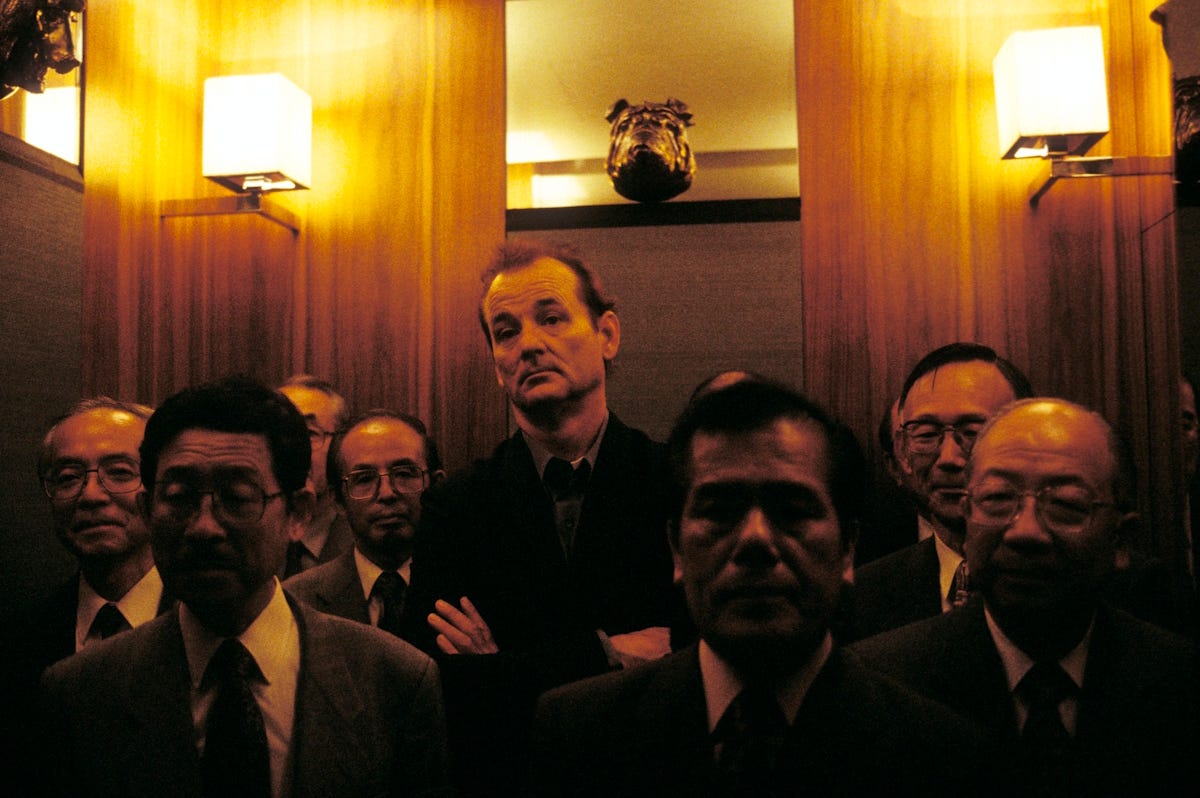
On the other hand, the film treats the Japanese themselves with faint ridicule, from Bob towering over Japanese men in the elevator to a recurring joke in which Japanese people speak Japanese with no apparent concern for whether Bob or Charlotte can understand them. That does make for the funniest scene when Bob is trying to understand his direction for the whiskey commercial, and at least in this case receives (poor) translation. Unfortunately, Coppola keeps repeating the joke to diminishing returns. Most people aren’t so oblivious as to keep talking to someone when they realize that person doesn’t understand a word they’re saying—especially, say, a doctor talking to his patient. But Coppola keeps going back to the well hoping for the same reaction. Haha, Japanese people in Japan don’t speak English! So funny.
Murray and Johansson are fine. The former enlivens the material with his trademark sardonic wit. When Bob shares his reflections on having kids, it feels like one of the few moments when the movie actually has something to say—except Charlotte in this scene is about as interesting as the “yes men” Socrates talks to in his early dialogues, merely affirming whatever Bob says. Conversely, when Charlotte expresses her impasse, “I just don’t know what I’m supposed to be,” Bob responds with some substantive advice. Neither of these two characters are all that interesting, but Murray gets better lines to sink his teeth into.
The film has some nice ambience, like scenes at the smoky hotel bar with jazz musicians playing in the background. People who enjoy “vibes movies” might enjoy Lost in Translation, but I just wasn’t feeling its vibe after the first half hour or so and found myself frequently checking the time. At a couple brief moments near the end the camera isn’t even in focus. Meanwhile—another spoiler if you’ve made it this far—a kiss between two characters that should be a climactic moment is filmed at such an awkward angle that we barely see their lips touch.
And then the movie’s over, and I’m glad it’s over, which is exactly the wrong vibe for a story about two characters who don’t want to leave each other. I on the other hand had no issues saying goodbye to them. Unless you’re really keen to see Bill Murray flex his dramatic muscles a little, or are just happy to sit through a Tokyo travelogue, you won’t miss much by skipping this one.