
Michael (2026)

8/10
Just when musician biopics were starting to experiment with the likes of Elvis and Better Man, along comes the King of Pop to give the standard biopic formula a new lease on life. Three weeks into its release, Michael—which covers Michael Jackson’s life from his time as a child star in The Jackson 5 through adult solo stardom with Off the Wall and Thriller to the Bad tour in 1988—has become the highest-grossing musical biopic of all time in North America and internationally is hot on the trails of Bohemian Rhapsody, the genre’s current box office champ worldwide.
While I consider myself a fan of Michael Jackson as a musician and entertainer—who doesn’t?—going in my expectations were low, as reviews have skewed negative. The main criticism is that Michael epitomizes the sanitized, cookie-cutter nature of musical biopics, which is arguably true, and unsurprising given the involvement of the Jackson family. Not only are most of Michael’s siblings executive producers, but the singer’s own production company Optimum Productions is credited. If the Jacksons’ oversight wasn’t incentive enough for this movie to play it safe, a legal settlement that prohibits any reference to the 1993 sexual abuse allegations against Michael forced the producers to revise the third act with costly reshoots.
Yet I would be lying if I said I didn’t find Michael an entertaining and enjoyable film, one that offers more insight into the human being behind the pop icon than most critics give it credit for. Director Antoine Fuqua, writer John Logan, and their main cast and crew are pros and the film is extremely well-crafted on a technical level, regardless of how much interference from the studio, the Jackson family, legal pressures, etc. might have shaped the final product.
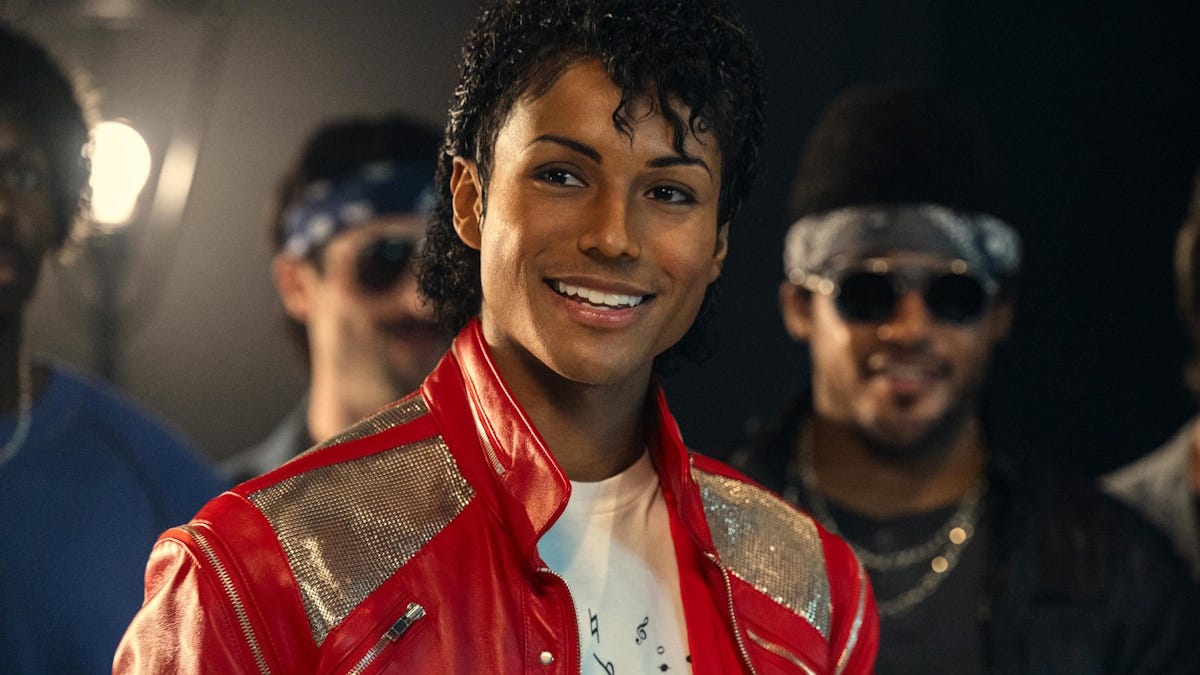
The biggest question revolved around the title performance. Casting Michael’s nephew Jaafar Jackson was an incredible gamble, given that he had no professional acting experience before taking the lead role in a $200-million film. Against all odds, his casting turns out to be a brilliant master stroke.
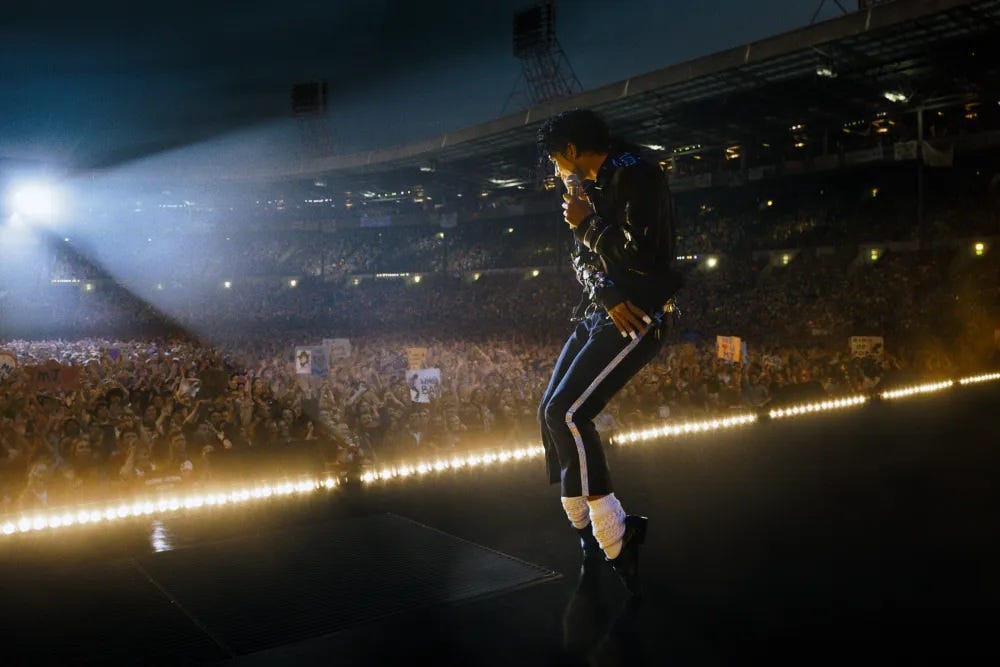
Playing a famous person is difficult when the original person’s image is so ingrained in our minds, especially for a ubiquitous celebrity in the age of mass media. But Jaafar looks so much like Michael, has mastered his physical and vocal mannerisms and dance moves so well, that we often forget we’re seeing a performance and just see Michael Jackson. Even the best impersonation, however, wouldn’t mean anything if Jaafar couldn’t act well in the dramatic scenes, and he absolutely does, more than holding his own against veteran thespians. Whether or not he goes on to act in other roles, his performance here is a home run.
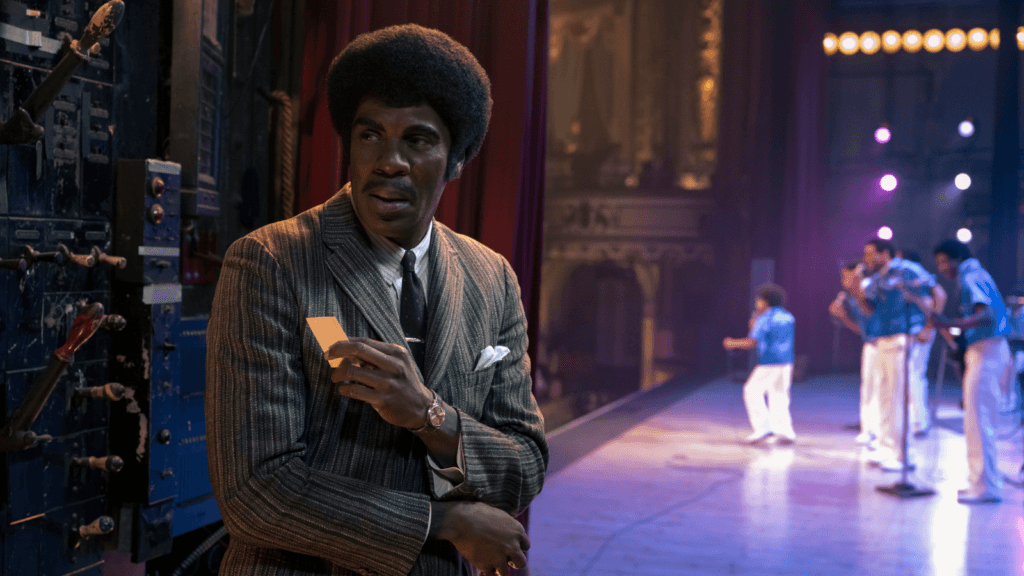
Logan’s script avoids the pitfall of becoming just a “greatest-hits” recap of Michael’s career by finding a dramatic angle that focuses on the singer’s relationship with his abusive father Joseph (Colman Domingo) and his desire to assert his personal, professional and artistic freedom. Domingo delivers an effective performance under heavy prosthetic makeup that makes him a dead ringer for the Jackson patriarch without ever being distracting. The rest of the supporting cast are all solid in stock roles, particularly Nia Long, who portrays mother Katherine Scruse-Jackson as a sensitive, nurturing contrast to the authoritarian Joseph.
Promotional clips for Michael highlighted re-creations of iconic Jackson performances, from his rendition of “Billie Jean” at the Motown 25 TV special which popularized the moonwalk to the zombie dance in the “Thriller” music video. Similar to how Bohemian Rhapsody—like Michael, produced by Graham King—heavily leaned on its re-creation of Queen’s iconic Live Aid performance, these clips made me cynical about the film being more glorified cosplay regurgitating yesterday’s pop culture. Why watch a re-creation when we can just watch the actual Michael Jackson performances and videos on YouTube?
In the context of the film, however, these re-creations do exactly what they’re supposed to do: enhance the story and drama. Reluctantly performing on the Jacksons’ Victory Tour, for example, Michael stares daggers at his father while singing the line, “You got me working day and night.” Contrary to critics who allege that Michael is reluctant to explore its subject, the film provides many glimpses into Michael Jackson’s creative process. Early on, we see him mimicking James Brown’s stage movements. It must be noted that child actor Juliano Valdi also does a great job playing young Michael. Casting directors Kimberly Hardin and Victoria Thomas earned their paycheques on this film.
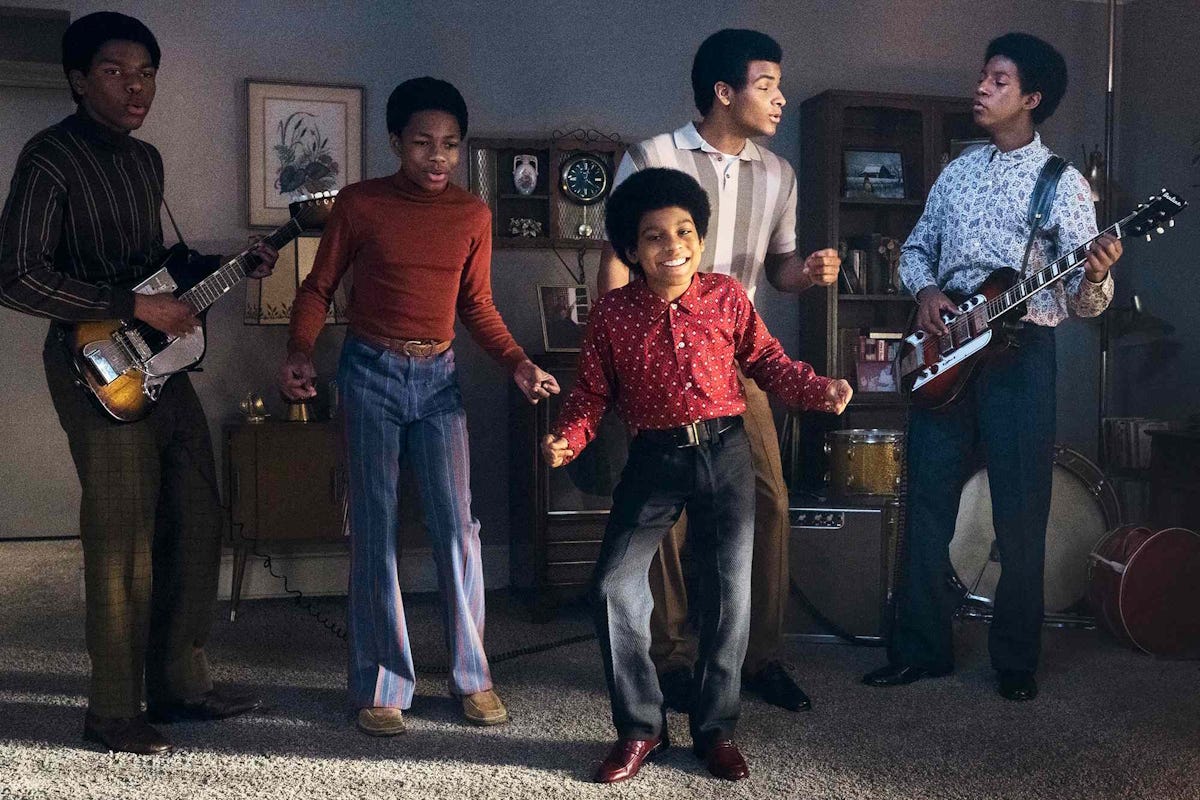
Later we see Michael watching Charlie Chaplin films and Gene Kelly dancing in Singin’ in the Rain, which influence his music videos. During the “Thriller” video shoot, he stresses to director John Landis the importance of making sure the framing captures his feet, a tip he learned from Fred Astaire. It’s equally fascinating to watch Michael refine the dance in the “Beat It” video. We see his songwriting process and deliberations over the perfect track order for Thriller.
Critics who deride the film have cited how it avoids any reference to the abuse allegations against Jackson. On the contrary, it presents him as a messianic figure who deeply cares for children. While the scenes of him visiting sick children in hospitals may be true to life, by avoiding mention of later abuse allegations the filmmakers are arguably guilty of whitewashing and lying by omission. Indeed, the film runs screaming from any mention of Jackson’s sexuality whatsoever. From a commercial perspective, playing it so safe in this regard is understandable, since it avoids a potential minefield. One can make a valid argument, however, that avoiding this topic completely is an act of creative dereliction.
The same could be said for the way the film presents Michael’s brothers as glorified extras (sister Janet Jackson, a pop icon herself, doesn’t appear at all after declining to allow the filmmakers to use her likeness). Of course we can learn a lot about a person from their relationship with their siblings. But ultimately this is a film that’s slightly over two hours, portraying decades in the life of one of history’s greatest entertainers. At this running time the filmmakers have to pick and choose what to focus on while providing a dramatically satisfying narrative. Their decision to concentrate on Michael’s relationship with his father, and his effort to establish his independence, is a valid creative choice.
For all the claims that Michael is more of an advertisement than a biopic, I do believe it gives us better understanding of Michael Jackson as a person. Here was a prodigious talent denied a childhood, yet who spent his formative years learning from the greatest musical talents of his time; whose abusive father literally whipped into him an obsessive perfectionist streak, but also inculcated self-consciousness and insecurity about his physical appearance, calling him “big nose.”
When we see Jackson undergo his first rhinoplasty, the plastic surgeon asks him if he’s sure he wants to go through with the procedure, noting, “You’re a really good-looking kid.” Michael responds that he has to be “perfect.” The film shows Michael’s efforts to conceal his vitiligo. His friendship with animals, which starts as a boy when he’s unable to relate to other children his own age, takes on new resonance—as does his fascination with Peter Pan, beyond the trope about not wanting to grow up. When we consider that it’s a tradition in stage and film productions of Peter Pan for the same actor playing father George Darling to play the villainous Captain Hook, the connection with Joseph Jackson becomes clear.
We also gain a new appreciation for the 1984 incident in which Jackson suffered severe burns while shooting a Pepsi commercial and almost died. When a doctor prescribes painkillers to the reluctant singer, it’s an ominous development knowing that Jackson would die in 2009 after his personal physician inadvertently overdosed him with propofol, a surgical anesthetic. Like the scenes in which he gets his first nose surgeries, the knowledge of what happened later gives more weight to what the film depicts. For all the accusations of sanitizing Jackson’s life, Michael helps you understand why it took the course it did.
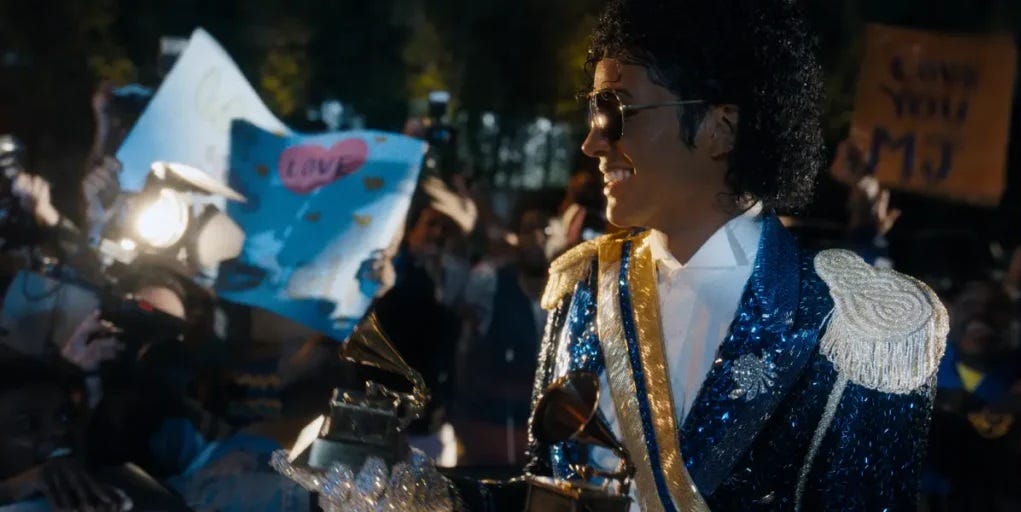
If someone wants to say this film is a surface-level examination of Jackson that plays it too safe, I won’t argue. Jackson as an artist distinguished himself by taking creative chances and bold swings, which this movie never does. It’s a celebration of Michael Jackson and his music—and to be sure, an act of brand management, which like Elvis aims to revitalize an artist for a new generation of fans so his estate can continue making money off him for years to come.
Nevertheless, I enjoyed the movie. What can I say? It’s engaging, technically proficient and well-acted; offers greater comprehension of Michael Jackson as a man and an artist, despite refusing to tread into controversial areas; and its soundtrack consists of song after song of some of the greatest pop music ever recorded. All that elevates what would otherwise be a fairly generic musical biopic.
One final note: the film ends with what must be one of the strangest sequel teases ever, with the caption “His story continues…” following a triumphant performance of “Bad” in 1988. Every viewer knows his story becomes a lot darker after that. While the cast and filmmakers clearly have the ability, I can’t imagine a second film will see the light of day—not just due to the legal obstacles, but because it’s impossible to make a feelgood version of that period in Michael Jackson’s life. If high box office grosses compel them to try, how they navigate that challenge will be interesting to see.