
Backrooms (2026)

7/10
More of an art piece than a traditional horror film, Backrooms feels like a movie that will reward repeat viewings. Director Kane Parsons, making his feature debut after gaining a following with short films on YouTube, displays impressive ambition, technical skill, and a penchant for unconventional choices. The story holds together well enough as a psychological study of memory and trauma, although the world of “the Backrooms” can either become more intriguing or more silly the longer you think about it—a suspicion confirmed by 15 minutes of post-credits bonus footage in the extended version I saw, titled Backrooms: Everything Must Go Edition.
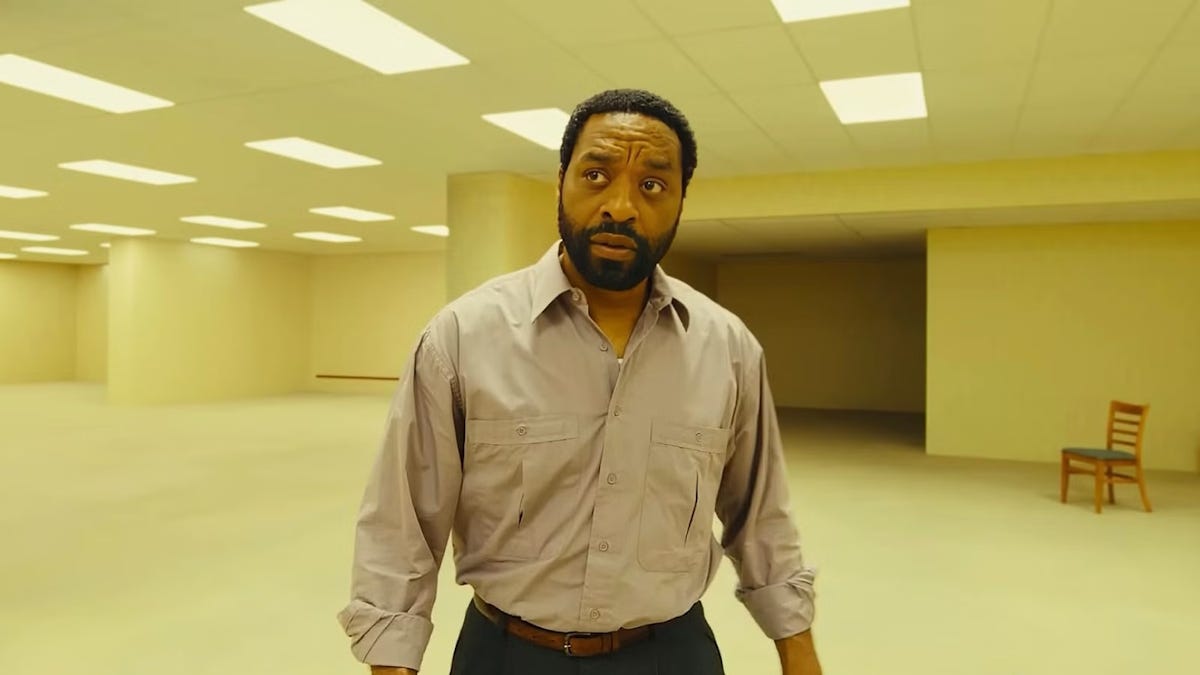
Inspired by internet lore that started with a photo on 4chan of an empty former furniture store under renovation in Oshkosh, Wisconsin, Parsons’ film—written by Will Soodik—follows Clark (Chiwetel Ejiofor), a failed architect who now owns a failing, pirate-themed furniture store called Cap’n Clark’s Ottoman Empire. Struggling with alcoholism after a divorce and meeting regularly with therapist Mary Kline (Renate Reinsve), Clark discovers a portal in the store’s basement into a surreal liminal space characterized by yellow hallways and rooms strewn with apparently random objects, where everything feels “off.” Return trips soon make clear that visitors are not alone in the Backrooms.
A dreamlike atmosphere pervades the film, at times outside the Backrooms themselves. When an electrician visits Clark’s furniture store, which has been experiencing odd flickering power outages, and discovers three red switches at the bottom of the breaker box installed at weird angles and unconnected to anything else in the building, it’s our first indication that the Backrooms may extend beyond the space that Clark finds through the portal. As we learn, the true source of objects and inhabitants within the Backrooms are what people from outside bring in.
Spoilers ahead.
Exploring the Backrooms, we gradually come to understand that these spaces are a repository of memory. As Clark tells Mary when she enters to look for him, the Backrooms provide echoes of “every place that ever was.” Yet just as memory is imperfect, so too are the objects and beings inside this dimension. “Imagine describing a dog to someone who's never seen one before and then asking them to draw it,” Clark says. “It will look similar, but the devil is in the details.”
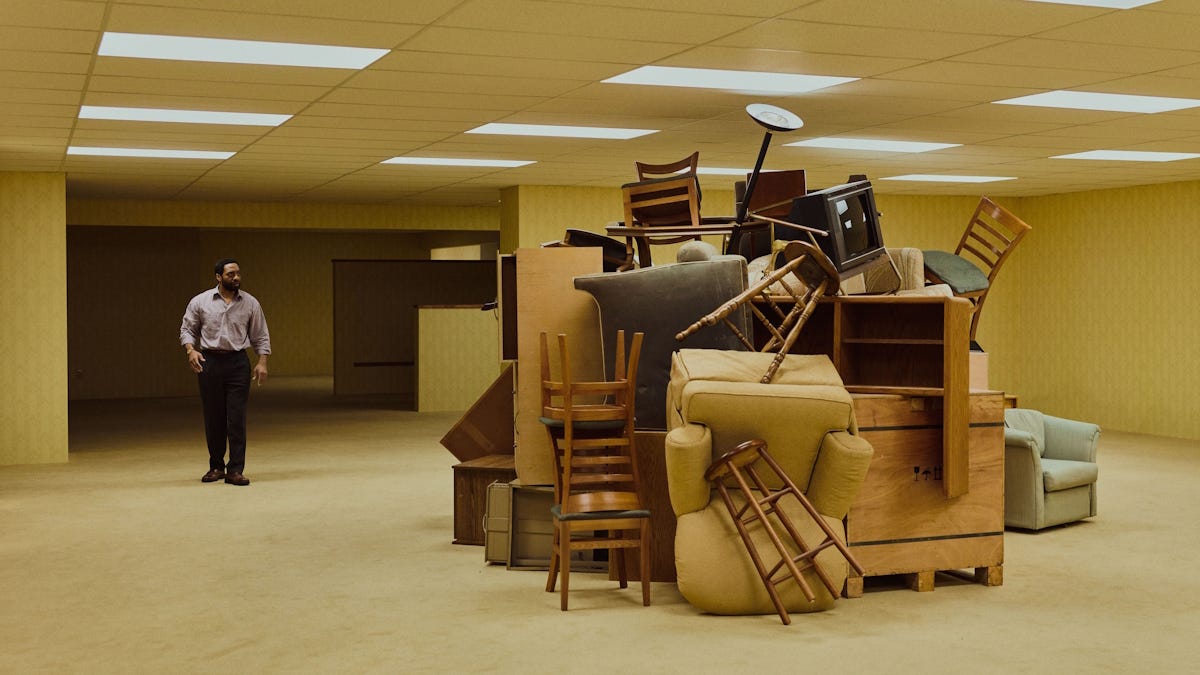
Deviations start with bizarrely shaped inanimate objects, or furniture buried halfway in the carpeted floor of the Backrooms. Eventually we discover what appear to people with deformities, such as having six eyes or seven fingers. However, these beings have no feelings. “Can you imagine how good that must feel?” Clark asks. “There's no thoughts, no pain, no ego. No fear. They simply… exist. Like furniture.” Indeed, the deformed individuals are full of stuffing similar to upholstery in furniture. “The best part,” Clark says, is that “you can eat them.”
While visually striking, the nature of these beings makes less sense given what we’re told about the Backrooms representing memory. True, we remember things imperfectly. But as hazy as the details can be when we recount a story from years ago, we don’t remember a person in the story as having six eyes. One possible interpretation, even if it’s never stated in the film, is that the Backrooms are an entity similar to artificial intelligence (AI) that recreates objects or beings imperfectly because it’s not conscious and doesn’t understand them, similar to AI-generated images of people with the wrong number of fingers.
If that’s the case, it’s a missed opportunity for the film, which could have served as a more direct commentary on AI. To be fair, it did inspire the comparison. But for some reason, Parsons chose to set his film in 1990, so characters use analog video recorders and landline telephones. I’m not sure why he opted for this period, other than perhaps technostalgia—an aesthetic preference for older formats such as analog video. While a valid creative choice, it is ironic given the reputation of Backrooms—along with the other buzzy horror film of the moment, Obsession—as a “gen Z” movie.
On the other hand, much of the strength of Backrooms flows from Parsons’ unexpected directorial choices. Mike Stoklasa and Jay Bauman of Red Letter Media have praised the film’s bright lighting, which actually contributes to the unsettling quality of the Backrooms—the opposite of conventional thinking in which dark or poor lighting makes horror films scarier. Parsons allows scenes to breathe at an unhurried pace, with long scenes of characters wandering around. He avoids excessive jump scares or explaining everything in a way that would ruin the story’s mystery or intrigue. A corporation called Async, which originally manufactured MRI machines, has devoted its resources to studying the Backrooms, but scientist Phil (Mark Duplass) offers the bare minimum of explanation, which is for the best.
Climactic action involving a giant distorted simulacrum of Clark as his store’s pirate mascot, which the script calls “the Lifeform,” walks a fine line between creepy and silly. The Lifeform is jarring and unsettling; Parsons wisely never lingers on it too long to avoid exposing any cheap effects, even if Backrooms had a decent budget of $10 million for the debut of an unproven filmmaker. However, scenes in which the monstrous pirate bites a chunk out of Clark or chases a terrified Mary through the Backrooms are perhaps more comedic than intended.
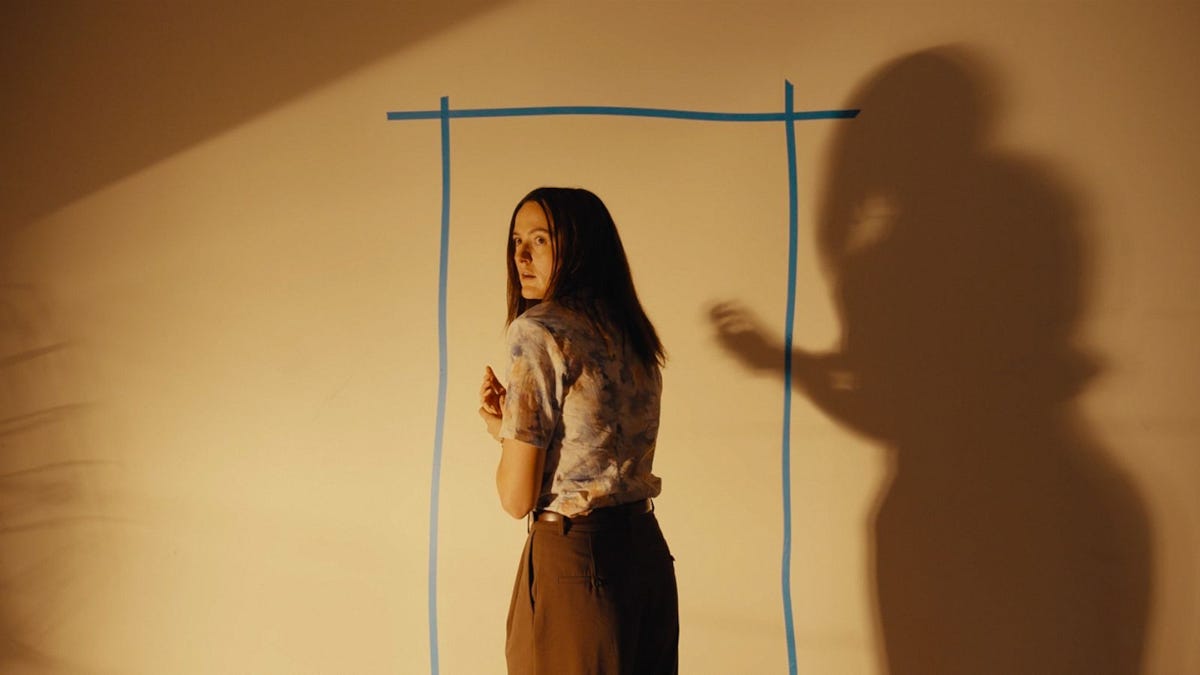
Mary’s backstory is muddled and less effective than Clark’s, despite the “show, don’t tell” rule. Ejiofor gets to act out past conflict with his ex-wife during a therapy session with Mary, which at least allows us to feel his frustration and regrets. Parsons shows the demolition of Mary’s childhood home and the institutionalization of her agoraphobic mother, but I never felt as much for her character, though Reinsve is at the centre of the movie’s final, unnerving image.
I enjoyed and admired Backrooms, even if I didn’t quite love it. But the film succeeds more often than not as an absorbing, unpredictable experience. It’s always more interesting when a movie swings for the fences. We’re in an exciting moment when audience tastes are changing, and new talents are coming to the fore who speak to a generation that has come of age amid chronic instability and crisis. Parsons—who also co-scored the film’s dark ambient music with Edo Van Breemen—deserves credit for giving us something fresh and different, establishing himself as a bold, innovative young filmmaker at just 20 years old. I can’t wait to see what he does next.
I understand your criticisms, but I loved this one. 9/10.